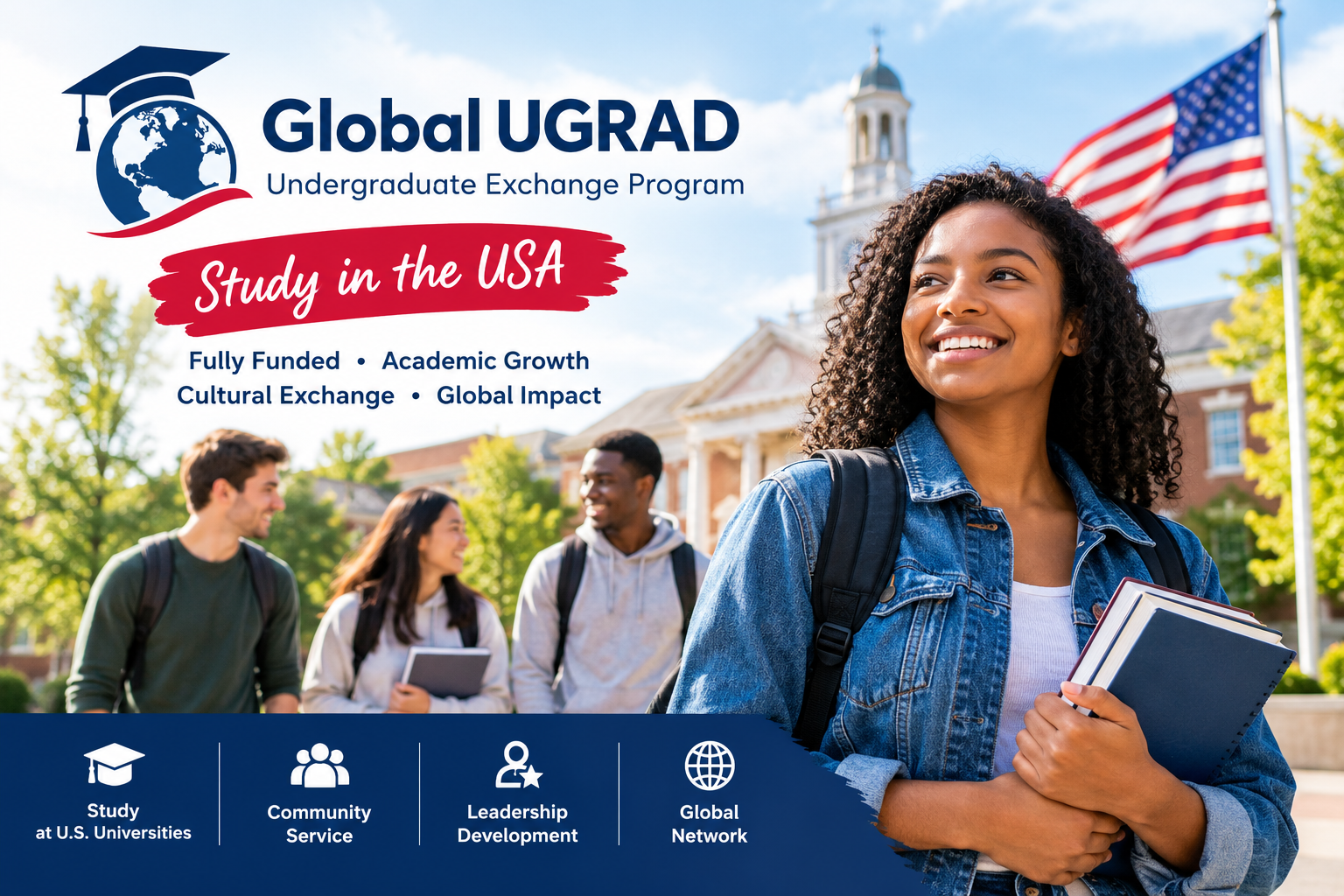
Are you an undergraduate student who dreams of studying in the United States, experiencing a new academic environment, and developing the leadership skills needed to make a difference in your community? The Global Undergraduate Exchange Program (Global UGRAD) offers an exciting opportunity to pursue a semester of non-degree study at a U.S. college or university through an international educational and cultural exchange.
Sponsored by the U.S. Department of State’s Bureau of Educational and Cultural Affairs, the Global UGRAD program brings talented undergraduate students from participating countries to the United States for academic enrichment, community service, professional development, and cultural exchange.
Unlike a traditional university scholarship that supports an entire degree, Global UGRAD is designed to give students an immersive international learning experience while they remain enrolled at their home institutions. Participants attend classes, interact with American students, participate in community activities, and develop a broader understanding of different cultures and perspectives.
For eligible students who want to expand their horizons without independently shouldering the major costs of an international exchange, this program is an opportunity worth exploring.
In this comprehensive guide, you will learn what the Global UGRAD scholarship offers, who can apply, which expenses are covered, how the application process works, and how to prepare a competitive application.
What Is the Global Undergraduate Exchange Program (Global UGRAD)?
The Global Undergraduate Exchange Program, commonly known as Global UGRAD, is a competitive international exchange initiative sponsored by the U.S. Department of State and administered by World Learning in participating countries and regions.
The program gives selected undergraduate students the opportunity to study at accredited colleges and universities in the United States for one academic semester without pursuing a U.S. degree.
Its primary objectives include strengthening participants’ academic knowledge, developing leadership and professional skills, promoting community engagement, and encouraging mutual understanding between people from different countries.
During the exchange, participants take full-time academic courses, engage in community service, participate in cultural activities, and interact with students and members of their host communities.
The program is also designed to encourage participants to apply the knowledge and experience they gain in the United States to their studies, careers, and communities after returning home.
For more information, visit the official Global UGRAD website.
Global UGRAD Scholarship 2026/2027: Key Details
Before beginning your application, it is important to understand the main features of the program.
- Scholarship name: Global Undergraduate Exchange Program (Global UGRAD).
- Sponsor: U.S. Department of State, Bureau of Educational and Cultural Affairs.
- Program type: International undergraduate exchange.
- Study destination: Participating colleges and universities in the United States.
- Duration: One academic semester.
- Qualification awarded: No U.S. degree; the program is a non-degree exchange.
- Funding: Major program-related expenses are covered for selected participants.
- Academic disciplines: Opportunities depend on available host institutions and course offerings.
- Application method: Through the designated application process for eligible countries.
- Selection process: Competitive, with consideration given to academic performance, leadership potential, and community involvement.
Important: Application dates, country participation, eligibility rules, and selection arrangements can change between cycles. Applicants should confirm the latest information with the relevant U.S. Embassy, Fulbright Commission, or official program website before applying.
Benefits of the Global Undergraduate Exchange Program Scholarship
One of the most attractive features of Global UGRAD is that it combines academic study with cultural immersion and professional development. Rather than focusing exclusively on classroom learning, the program encourages participants to become active members of their host communities.
Here are some of the major benefits available to selected students.
1. Financial Support for Studying in the United States
International travel and university living expenses can make studying abroad financially difficult for many undergraduate students. Global UGRAD helps address this challenge by covering major costs associated with participation.
According to the official program information, covered expenses generally include:
- International round-trip economy airfare.
- Tuition and required university fees.
- On-campus accommodation.
- Meals.
- Required textbooks and study materials.
- A monthly maintenance stipend.
- A pre-departure travel allowance.
- Limited health benefits coverage.
- Expenses associated with designated program workshops and activities.
These benefits allow selected participants to focus more fully on their academic and cultural exchange experience.
However, applicants should review the official funding terms carefully. Coverage is subject to the program’s conditions, and limited health benefits should not automatically be interpreted as comprehensive health insurance for every possible medical expense.
2. Study at a U.S. College or University
Global UGRAD gives participants the opportunity to experience American higher education firsthand.
Students attend classes, complete assignments, participate in group projects, and interact with professors and classmates from different backgrounds.
This experience can help participants discover new approaches to learning, improve their research skills, and explore academic subjects beyond their usual university environment.
It can also help them understand how American colleges and universities approach classroom participation, independent study, collaboration, and critical thinking.
The specific institution and available courses depend on the program’s placement process. Finalists do not simply choose any university in the United States; placements are arranged according to the program’s procedures and relevant academic considerations.
3. Develop Leadership and Professional Skills
Leadership development is an important part of the Global UGRAD experience.
Participants engage in activities designed to strengthen their communication, teamwork, problem-solving, and cross-cultural collaboration skills.
Through academic projects, community service, and professional development activities, students learn how to work with people who have different experiences, opinions, and perspectives.
These skills can be valuable when applying for graduate school, pursuing internships, seeking employment, or taking on leadership responsibilities in student organizations and community initiatives.
4. Experience American Culture
Living and studying in the United States offers students the opportunity to experience American culture beyond what they may have encountered through books, television, or social media.
Participants interact with American students, learn about local communities, attend cultural activities, and explore different aspects of American society.
The exchange is also an opportunity to introduce others to their own countries, traditions, languages, and perspectives.
This two-way exchange is central to the program’s purpose of building mutual understanding between people from different parts of the world.
5. Participate in Community Service
Community engagement is a core component of Global UGRAD.
Participants are expected to complete community service as part of their exchange experience. The official program overview specifies a requirement of 20 hours of community service.
Activities may include volunteering with local organizations, supporting community initiatives, participating in educational activities, or contributing to other approved projects.
Through these experiences, students can develop a stronger understanding of civic responsibility and discover practical ways to contribute to their communities.
6. Build an International Network
Studying abroad creates opportunities to develop relationships with fellow exchange students, American classmates, lecturers, community leaders, and professionals.
These connections can provide opportunities for collaboration, mentorship, cultural exchange, and future academic or professional engagement.
Global UGRAD alumni also form an international community of former participants who share an interest in leadership, education, and community development.
Although participation does not guarantee a job, admission to graduate school, or future funding, the experience can help students build relationships and develop skills that support their long-term goals.
Eligibility Criteria for the Global UGRAD Scholarship
Global UGRAD is competitive, and meeting the basic eligibility requirements does not guarantee selection.
Applicants must satisfy the official requirements applicable to their country and application cycle. The following criteria are useful starting points when assessing whether you may qualify.
1. Citizenship and Country of Residence
Applicants must be citizens of a participating country or eligible area and generally must be residing in that country when applying.
The program is not automatically open to every international student. You should confirm that your country is included in the relevant application cycle and identify the organization responsible for administering applications in your location.
2. Undergraduate Enrollment
Applicants are expected to be enrolled in an undergraduate program at an eligible, accredited institution in their home country.
The program is intended for students who will return to their home institution after the exchange rather than students seeking to transfer permanently to a U.S. university through this scholarship.
3. Age and Academic Standing
The general eligibility information published by the U.S. Department of State specifies that applicants must be over 18 years old and enrolled in good academic standing.
Students should check the exact requirements for their country, including any conditions relating to the number of years remaining in their undergraduate degree.
4. English Language Ability
Because participants study in an English-speaking academic environment, they must have sufficient English-language skills to participate successfully.
The program may require a TOEFL or Duolingo English Test score, depending on the applicable selection and placement requirements. Some finalists may receive access to virtual English-language training.
Do not assume that every applicant must submit a test score at the initial application stage. Follow the instructions issued for your specific application cycle.
5. Leadership Potential and Community Involvement
The selection process considers more than academic grades.
Applicants should be prepared to demonstrate their leadership potential, initiative, extracurricular participation, and involvement in activities that benefit others.
Examples may include volunteering, serving in student associations, organizing educational projects, supporting community initiatives, or helping solve problems within your university or local community.
Formal leadership titles are not the only way to demonstrate leadership. What matters is your ability to explain what you contributed, what you learned, and how your actions made a difference.
6. Commitment to Returning Home
Participants must be willing to return to their home country after completing the exchange.
Global UGRAD is designed to help students strengthen their knowledge, skills, and perspectives so they can apply them to their future studies, careers, and communities.
Applicants must also be able to meet the program’s visa and participation requirements.
Eligibility reminder: The points above are a general guide, not a substitute for the official eligibility checklist. Confirm all requirements before investing time in an application.
Which Countries Can Apply for Global UGRAD?
The Global Undergraduate Exchange Program serves students from participating countries and areas across several world regions.
These include:
- East Asia and the Pacific.
- Europe and Eurasia.
- The Middle East and North Africa.
- South and Central Asia.
- Sub-Saharan Africa.
- The Western Hemisphere.
Participation varies according to the program’s arrangements for each cycle. Not every country is necessarily included every year, and different countries may have different application instructions and deadlines.
If you are applying from Nigeria, Ghana, Kenya, South Africa, or another African country, for example, do not rely solely on a general list of eligible regions. Check the relevant U.S. Embassy or Fulbright Commission announcement to establish whether applications are available to students from your country.
You can begin with the official U.S. Department of State Global UGRAD page.
How to Apply for the Global Undergraduate Exchange Program Scholarship
Preparing a strong application requires attention to detail, thoughtful essays, and an understanding of what the selection committee is looking for.
The exact application procedure can differ by country, but the following steps provide a practical preparation guide.
Step 1: Confirm Your Eligibility
Before starting an application, review the eligibility criteria for your country and the relevant academic year.
Confirm that:
- Your country is participating in the program.
- You meet the citizenship and residence requirements.
- You are enrolled in an eligible undergraduate program.
- You meet the age and academic-standing requirements.
- Your English-language ability meets the applicable standard.
- You can satisfy the program’s visa and return-home requirements.
If any requirement is unclear, contact the relevant U.S. Embassy, Fulbright Commission, or program administrator before proceeding.
Step 2: Check the Application Announcement and Deadline
Application dates vary by country and program cycle.
The official Global UGRAD timeline indicates that student applications have commonly opened around November and December, followed by interviews in the early part of the following year. However, these dates should be treated as a general guide rather than a guaranteed deadline for every country or cycle.
Visit the official Global UGRAD application page and check the current announcement for your location.
Do not wait until the final day to begin your application. Allow sufficient time to prepare essays, request academic records, obtain recommendations, and resolve technical problems.
Step 3: Prepare Your Supporting Documents
Read the official application instructions to determine which documents are required.
Depending on the application cycle, you may need to prepare:
- Academic transcripts or records.
- Evidence of current undergraduate enrollment.
- Personal essays or written responses.
- Information about extracurricular activities and community involvement.
- Details of leadership experience.
- Contact information for academic referees, if requested.
- English-language test information, where applicable.
- Other documents specified in the official announcement.
Keep your documents organized and ensure that the information you provide is accurate and consistent.
If you need an official transcript or recommendation, request it early rather than waiting until the application deadline approaches.
Step 4: Complete the Application Form
Use the application route designated for your country.
Enter your personal, academic, and extracurricular information carefully. Make sure that your contact details are correct and that you follow the instructions for uploading documents and submitting written responses.
Before submitting, review every section for missing information, spelling errors, and inconsistencies.
Save a copy of your essays and any application confirmation for your records.
Step 5: Write Compelling Personal Essays
Your essays are an opportunity to explain who you are, what motivates you, and how the exchange fits into your academic and professional goals.
Rather than simply stating that you want to study in America, explain why the experience matters to you and how you intend to use what you learn.
For example, you might discuss a challenge you helped address in your university or community, a leadership experience that shaped your outlook, or an academic interest you want to explore through international exchange.
Whenever possible, use specific examples rather than broad claims.
Explain what you did, why you did it, what the experience taught you, and how it relates to your future plans.
Your essays should reflect your own experiences and ideas. Follow the official word limits and avoid copying generic scholarship essays from the internet.
Step 6: Attend an Interview if Invited
Shortlisted applicants may be invited to participate in an interview conducted through the relevant U.S. Embassy, Fulbright Commission, or designated selection process.
If you are invited, prepare to discuss your academic interests, community involvement, leadership experience, and reasons for applying.
You may also be asked how you would adapt to a new academic environment, contribute to cultural exchange, or use the experience after returning home.
Practise explaining your ideas clearly and honestly. The goal is not to memorize impressive answers but to demonstrate that you understand the program and have thought carefully about your participation.
Step 7: Complete Any Additional Selection Requirements
Candidates who progress through the selection process may be required to complete further steps, such as English-language testing, placement procedures, medical documentation, or visa preparation.
Follow all instructions issued by the program administrators and meet the relevant deadlines.
Being shortlisted does not necessarily mean that every remaining requirement has been completed or that final participation is guaranteed.
Step 8: Prepare for Your Exchange
Successful participants receive further information about their placement, travel arrangements, orientation, and other pre-departure requirements.
Once your participation is confirmed, prepare to adjust to a different academic system and living environment.
Learn about your host institution, organize your travel documents, review program expectations, and think about the academic and personal goals you want to achieve during your semester in the United States.
What Expenses Does the Global UGRAD Scholarship Cover?
Understanding the funding arrangements can help applicants assess the financial value of the program.
The official Global UGRAD frequently asked questions page identifies the following covered expenses:
| Expense | Coverage |
|---|---|
| International travel | Round-trip economy-class airfare and a pre-departure travel allowance |
| University education | Tuition and required fees |
| Accommodation | On-campus housing |
| Meals | Meal provision through the program’s arrangements |
| Personal expenses | Monthly maintenance stipend |
| Academic materials | Required textbooks |
| Health-related support | Limited health benefits coverage |
| Program activities | Eligible expenses for designated workshops and activities |
Source: Official Global UGRAD FAQs.
These provisions make the program a significant opportunity for students who might otherwise find an international exchange financially challenging.
Nevertheless, applicants should confirm the exact coverage and any exclusions that apply to their placement. They should not assume that every incidental expense, personal purchase, or medical cost will be covered.
What Is Life Like as a Global UGRAD Scholar in the United States?
The Global UGRAD experience extends beyond attending lectures and earning academic credits.
Participants are expected to become involved in campus life, engage with their communities, and learn from people whose experiences may differ considerably from their own.
Academic Life
You will attend classes, complete assignments, participate in discussions, and work with other students.
American classroom environments may place considerable emphasis on independent learning, group projects, class participation, and critical thinking. Being willing to ask questions and engage respectfully with different opinions can help you make the most of the experience.
Campus and Community Life
Depending on your placement, you may participate in campus organizations, community activities, cultural events, and approved extracurricular programs.
These experiences provide opportunities to understand everyday life in the United States and build relationships beyond the classroom.
Cultural Exchange
Cultural exchange works in both directions.
You will have opportunities to learn about American customs and perspectives while sharing aspects of your own culture with classmates and community members.
Approaching these interactions with curiosity, respect, and an open mind can make the experience more rewarding.
Balancing Responsibilities
Participants must manage academic assignments, community service, professional development activities, and personal commitments.
Good time management, communication, and a willingness to seek help when needed can make the transition easier.
It is also normal to need time to adjust to unfamiliar surroundings. Staying connected with family while making an effort to build new friendships can help you settle into your exchange experience.
How to Improve Your Chances of Being Selected for Global UGRAD
Because the program uses a competitive selection process, a carefully prepared application can help you communicate your strengths more effectively.
No strategy can guarantee selection, but the following recommendations can improve the quality of your application.
1. Demonstrate Leadership Through Real Examples
Leadership does not always mean being the president of a student association or holding a formal position.
You might have organized a study group, helped coordinate a community initiative, volunteered to support younger students, or contributed to a project that addressed a local problem.
Describe your contribution clearly. Explain the situation, the action you took, and the outcome or lesson that followed.
2. Show Evidence of Community Involvement
The program values community engagement, so explain how you have contributed to activities beyond your academic responsibilities.
If you have volunteered with an organization, participated in a community project, or helped address a social or educational challenge, describe your role honestly.
If your experience is limited, focus on the meaningful contributions you have made rather than exaggerating your achievements.
3. Connect the Exchange to Your Academic Goals
Explain how studying in a U.S. academic environment could help you develop knowledge or skills relevant to your field.
For instance, a student interested in public health might want to explore different approaches to community education, while an engineering student might want to broaden their understanding of collaborative problem-solving.
Use examples that genuinely reflect your interests rather than choosing a field simply because it sounds impressive.
4. Explain How You Will Apply the Experience at Home
Global UGRAD is an exchange program, not simply an opportunity to travel abroad.
Show how you hope to apply your learning after returning to your home institution and community.
You might plan to share new academic approaches with fellow students, contribute to a community project, support an educational initiative, or use your improved skills in your future career.
Your plans should be realistic and connected to your existing interests and experience.
5. Write Clearly and Authentically
Avoid filling your essays with exaggerated claims or complicated language that does not sound natural to you.
Strong writing communicates clear ideas, provides relevant examples, and shows thoughtful reflection.
Proofread your essays carefully, respect the word limits, and ensure that every response answers the question being asked.
6. Prepare for the Interview
If you are invited to an interview, revisit your application and be ready to discuss the experiences you described.
Practise answering questions about your motivations, leadership, academic interests, and future plans.
Be prepared to explain how you would respond to unfamiliar situations and contribute positively to a diverse academic and cultural environment.
7. Follow Every Instruction
A strong profile cannot compensate for an incomplete application or failure to meet an essential requirement.
Check deadlines, document specifications, word limits, and submission instructions carefully.
Submit your application before the deadline and keep copies of important communications.
Career and Academic Benefits After Global UGRAD
Although Global UGRAD does not guarantee employment, graduate admission, or future scholarships, the experience can contribute to long-term academic and professional development.
Improved communication skills: Interacting with classmates, professors, and community members can help you communicate more effectively across different settings.
Cross-cultural competence: Working with people from different backgrounds can strengthen your ability to collaborate in international or multicultural environments.
Leadership development: Community service and professional development activities can help you become more confident in organizing projects and contributing to teams.
Broader academic perspectives: Exposure to different teaching methods and academic resources can introduce new approaches to your field of study.
Professional connections: Relationships developed during the exchange may provide opportunities for future collaboration, mentorship, and learning.
Greater confidence and independence: Living and studying in a new environment can help you develop adaptability, problem-solving skills, and a stronger understanding of your own goals.
The value of these benefits ultimately depends on how you use the experience and continue developing your skills after the program.
Common Challenges Global UGRAD Participants May Face
Studying abroad can be rewarding, but it also involves adjustment and responsibility.
Understanding potential challenges beforehand can help you prepare.
Cultural Adjustment
Every country has different social expectations, communication styles, and everyday routines.
Give yourself time to learn how things work in your new environment. Ask questions respectfully, remain open to unfamiliar perspectives, and avoid assuming that one culture’s practices are automatically better than another’s.
Different Academic Expectations
You may encounter unfamiliar teaching methods, assessment styles, or classroom participation requirements.
Review course expectations carefully, manage your assignments, and communicate with instructors or academic support staff when you need clarification.
Managing Time
Balancing classes, community service, professional development, and personal activities can be demanding.
Use a calendar or planner to organize deadlines and give important assignments sufficient time.
Homesickness
Being away from family, friends, and familiar surroundings can be difficult, especially during the early weeks.
Maintain healthy contact with loved ones while also making an effort to build friendships and participate in your host community.
Adjusting to a New Environment
Weather, food, transportation, accommodation, and daily routines may differ from what you are used to.
Prepare by researching your host location and following the advice provided during orientation. If you experience difficulties, contact the appropriate program staff or university support services.
Frequently Asked Questions About the Global UGRAD Scholarship
1. Is the Global UGRAD Scholarship fully funded?
Global UGRAD covers major expenses associated with the exchange, including tuition and required fees, accommodation, meals, round-trip economy airfare, required textbooks, a monthly maintenance stipend, and limited health benefits coverage. Review the official funding terms to understand exactly what is included.
2. Does Global UGRAD offer a full degree in the United States?
No. Global UGRAD is a one-semester, non-degree exchange program. Participants take courses at a U.S. institution but do not earn a U.S. degree through the program.
3. Can students from African countries apply?
Students from participating African countries may be eligible. However, eligibility depends on the country and the requirements for the specific application cycle. Check the announcement issued by your local U.S. Embassy or Fulbright Commission.
4. Do I need IELTS or TOEFL to apply?
English-language requirements depend on the official application and placement rules. TOEFL or Duolingo testing may be required at a particular stage, and some finalists may receive English-language training. Check the instructions for your country before booking a test.
5. Can I choose the U.S. university I want to attend?
Finalists do not generally select their host institution independently. The program arranges placements based on factors such as academic interests, available institutions, language-test results, and other relevant considerations.
6. Will the credits I earn in the United States transfer to my home university?
Credit transfer is not guaranteed by Global UGRAD. The decision rests with your home institution. Speak with your academic adviser or university administration before participating to understand whether and how exchange coursework may count toward your degree.
7. Do I have to return to my home country after the exchange?
Yes. Participants are expected to return to their home country after completing the program and must meet the applicable participation and visa requirements.
8. When does the Global UGRAD application open?
The application schedule varies by country and cycle. The official program timeline describes November and December as the usual application period, but you should verify the current deadline through the official application page or the U.S. Embassy or Fulbright Commission responsible for your country.
9. Does winning Global UGRAD guarantee a job in the United States?
No. Global UGRAD is an educational and cultural exchange program, not a job-placement or immigration program. Its purpose is to develop academic knowledge, professional skills, leadership, and mutual understanding.
10. Where can I find the official application?
Start with the Global UGRAD application page and the U.S. Department of State program information. Follow the country-specific instructions and use the designated application route.
Final Thoughts: Is the Global UGRAD Scholarship Worth Applying For?
The Global Undergraduate Exchange Program offers undergraduate students an opportunity to experience American higher education, develop leadership skills, participate in community service, and build international relationships through a funded semester of academic and cultural exchange.
For students who want to expand their academic horizons while remaining connected to their home institutions, it can be a valuable step toward personal and professional growth.
However, applicants should remember that Global UGRAD is competitive, eligibility varies by country, and participation does not guarantee future employment, immigration opportunities, or admission to a U.S. degree program.
The best way to prepare is to confirm your eligibility early, develop a clear understanding of the program, gather your supporting documents, and write thoughtful essays that demonstrate your genuine interests and contributions.
Ready to explore the opportunity? Visit the official Global UGRAD website and check the latest application information for your country. Start preparing early so that you are ready when the next eligible application cycle opens.